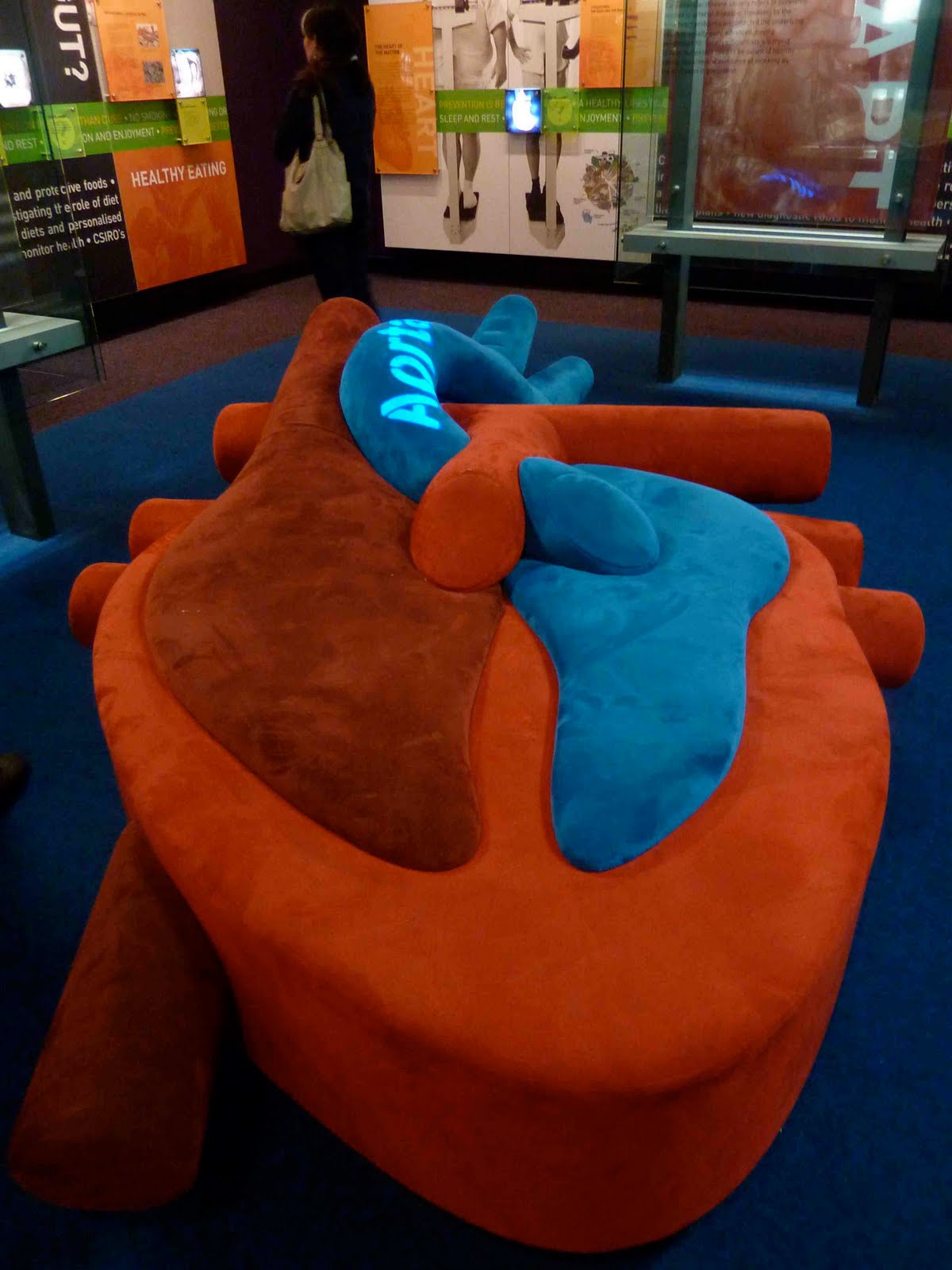
This afternoon my mom and I visited Questacon, Australia's National Science and Technology Centre. The name Questacon combines two words-'quest' meaning 'to discover' and 'con' meaning 'to study'.

These are some sculptures outside the Questacon building.


This is a wind power vehicle, a land yacht. Can you sail a land yacht on the table while the wind is blowing? It depends on how you set the sail, so that the land yacht can sail down wind or toward the wind.

Bicycle race. Can you guess which bicycle is going to win the race: recumbent bicycle or upright bicycle? Recumbent bicycle is a bicycle that places the rider in a laid-back reclinning position. This design has an ergonomic and an aerodynamic advantage.

Do you know how to power an aeromobile? It uses solar power!

Now it is about perception and deception.
Which face is normal?
Why was it so hard to judge whether a smiling mouth had been turned into a pout when the face was inverted? The area of your brain that is active when you analyze upright faces is the fusiform facial area, which borders your brain’s temporal and occipital lobes.


You probably find it difficult to look at this face. A section of our brain, fusiform gyrus, is specialized to recognize faces. The two sets of features on this face image compete with our usual face recognition technique, so it becomes difficult to look at this face.

What makes a face-human like? These pictures are made of one human face image, one lion face image and one gorilla face image. The images were cut into thin strips and pasted alternately together onto the back of tiny lenticular lenses.


This is an illusion image.
You may see one fuchsia-red and one orange spiral, but they are actually the same red color. The blue stripes influence your perception of the spiral colors due to color assimilation.

Stare into the center of this image and slowly move your head away and from and towards the panel. The spiral should appear to "twist" or zoom in and out, and the little stars should "twinkle" a little, even though it is a flat, static picture.

This is about a natural disaster.
There are many natural disasters happen everyday in the earth, including cyclone, floods, bushfire, drought, earthquake, tsunami, and volcano eruption.
Do you want to know about tornado? A vortex can occur when air or water moves quickly from one place to another. Air moves from a higher pressure area to a lower pressure area. Under certain conditions, the air rush can be great, and with warmer air rising, it can be almost like wind going ‘up the plughole’, swirling into a tornado. Tornadoes, cyclones and even a draining sink’s plug hole are naturally- occurring vortices.

Do you want to know about tsunami? Tsunami is a Japanese word, 津波, "tsu" meaning "harbor" and "nami" meaning "wave", given to large waves that sometimes devastated the shores and ports of Japan. A tsunami is a series of ocean waves with very long wavelengths (typically hundreds of kilometres) caused by large-scale disturbances of the ocean. These disturbances can either be from below (e.g. underwater earthquakes with large vertical displacements, submarine landslides) or from above (e.g. meteorite impacts).

Have you ever experienced an earthquake? I experienced the earthquake inside a house this afternoon, although it was only a simulation of an earthquake on 4.6 Richter scale. These are the condition in the kitchen and living room inside the house. We, the visitors, sat on a bench inside a house. There was a news on the television about an earthquake warning.


Suddenly the television was turned off. The electricity was out. The ground and everything were shaking....

... and at the end, there was a crack on the wall. Phew!

This is about water.
This is a hydrotram, a metaphor for major parts of the water cycle around the environment, from water catchments to our kitchen tap.


This is how we get our groundwater.

Have you ever thought about "hidden water"? Hidden water is the water that was used to produce an object. For example, the apple that we eat come from an apple tree that needed watering. Many cloths that we wear come from cotton trees that needed watering.
That's why we have to use everything wisely.
I also had a chance to see an "extreme environment" presentation. Yes, humans can adapt to many kinds of extreme environment, cause we can wear a snowsuit in the winter, a spacesuit for living in a space, a diving suit for underwater, etc. How about animals and plants? Organisms that thrive in extreme conditions are called "extremophiles", for example polar bears that live in the North pole, penguins in the South pole, camel and thorny devil in the desert, tube and pompei worms in the underwater (hyper extreme heat), and viperfish in the sub-abyss.
Well, I really enjoyed visiting Questacon. It is true that science is interesting!